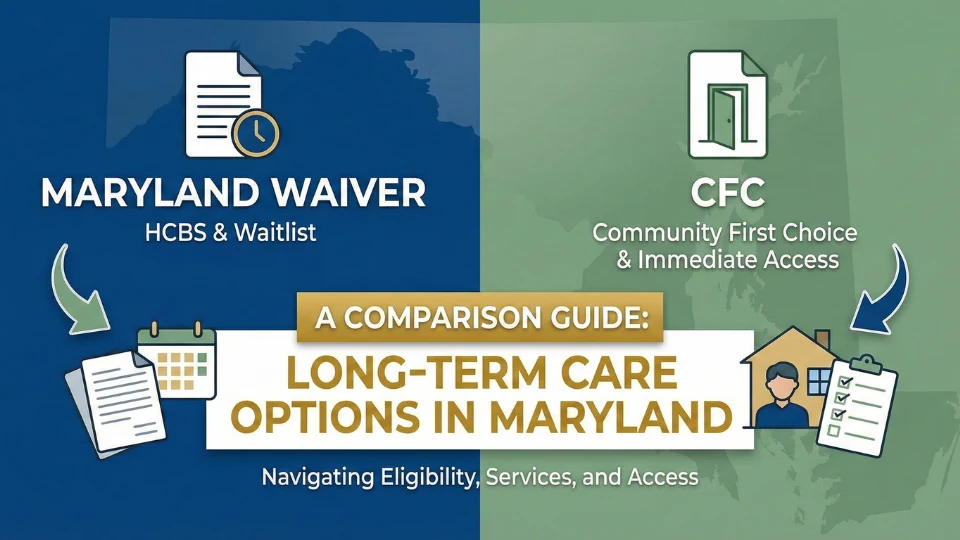
Maryland Waiver vs. CFC: Program Comparison Guide
If you or a family member requires long-term personal care at home, navigating state-funded support programs can feel overwhelming. In Maryland, two primary Medicaid programs provide coverage for in-home assistance: the Community First Choice (CFC) program and the Community Options Waiver (HCBOW). Both programs assist individuals with activities of daily living (ADLs) such as bathing, dressing, meal preparation, and mobility, but they differ significantly in eligibility, waitlists, covered benefits, and administration.
This comparison guide breaks down the core distinctions between Maryland Waiver programs and CFC to help you choose the right path for your family's care needs.
What Are Maryland Waivers and CFC?
Before comparing eligibility and benefits, it is essential to understand how each program operates under Maryland Medicaid regulations:
Community First Choice (CFC)
CFC is a Medicaid State Plan entitlement program regulated under COMAR 10.09.84. Because it is an entitlement, there is no waitlist for CFC—if an applicant meets health and financial criteria, services can begin as soon as the state assessment and plan of care are completed.
Home and Community-Based Options Waiver (HCBOW)
The Community Options Waiver is a limited-enrollment Medicaid waiver regulated under COMAR 10.09.54. Because enrollment slots are capped by state funding, HCBOW maintains a statewide Service Registry (waitlist) that often takes extended time to navigate unless an individual qualifies for an urgent priority category.
Key Differences: CFC vs. Community Options Waiver
| Feature / Criteria |
Community First Choice (CFC) |
Community Options Waiver (HCBOW) |
| Program Type |
Medicaid State Plan Option (Entitlement) |
Home & Community-Based Waiver (Capped) |
| Waitlist |
No Waitlist — Services start upon approval |
Yes — Statewide registry / waiting list |
| Level of Care |
Requires institutional / nursing facility level of care |
Requires institutional / nursing facility level of care |
| Covered In-Home Services |
Personal care ($18–$21/hr caregiver pay rate for non-medical aides), PERS, environmental adaptations, nurse monitoring |
All CFC services plus assisted living facility coverage, respite care, and behavioral health support |
| Caregiver Self-Direction |
Allows self-direction (qualifying family members can be paid caregivers) |
Allows agency-directed and self-directed care models |
Financial Eligibility Guidelines
Financial requirements vary depending on the specific program pathway:
- CFC Financial Eligibility: Applicants generally qualify through standard Medicaid or the Medically Needy spend-down program. Single applicant asset limits are typically set at $2,500.
- Community Options Waiver Eligibility: Allows higher income pathways (often up to 300% of the Supplemental Security Income rate) and utilizes federal spousal impoverishment protections (Community Spouse Resource Allowance) to protect joint assets for a healthy spouse remaining at home.
How to Apply for Maryland Care Programs
Applying for Community First Choice (CFC)
- Establish Medicaid Eligibility: Apply for Maryland Medicaid through your local Department of Social Services or the Maryland Health Connection.
- Request Assessment: Contact Maryland Access Point (MAP) or your local health department to request an Adult Evaluation Review Services (AERS) assessment.
- Nurse Assessment & Care Plan: A registered nurse evaluates ADL needs to determine approved monthly care hours.
- Select Agency & Caregiver: Choose a licensed Residential Service Agency (RSA) like Cottage Home Care Services to initiate care or onboard a paid family caregiver.
Applying for the Community Options Waiver
- Join the Service Registry: Call Maryland Access Point (844-627-5465) to place your name on the statewide waiver registry.
- Await Invitation: When your name approaches the top of the registry, the state sends an official application packet.
- Complete Medical & Financial Review: Submit required financial documents and schedule a clinical level-of-care evaluation.
Frequently Asked Questions
Can I apply for both CFC and the Community Options Waiver?
Yes. Many families enroll in Community First Choice to receive immediate in-home care while remaining on the Community Options Waiver registry for future assisted living benefits.
Can a family member get paid to provide care in Maryland?
Yes. Under CFC's self-directed option, adult children, siblings, or relatives can become paid caregivers ($18–$21/hr for non-medical personal care) if employed through a licensed agency and clear background checks. Legal guardians or power-of-attorney representatives cannot serve as paid caregivers.
What happens if I need care immediately?
Because CFC has no waitlist, applying for CFC or starting with private pay care are the fastest ways to secure immediate caregiver coverage.


 Alex TullaoRegistered Nurse