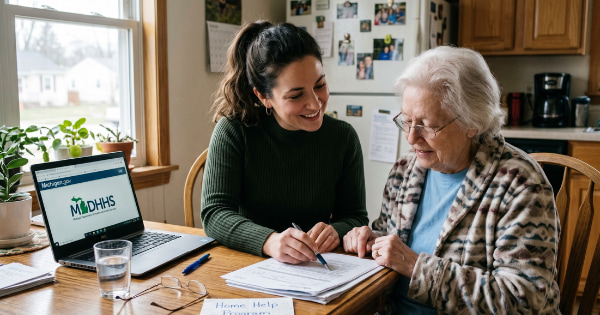
Linda's dad skipped his usual Sunday gravy and ordered a pizza instead. He blamed it on being tired. It wasn't a big deal on its own, but it was the kind of small change that gets a family's attention.
In-home help for seniors means practical, nonmedical support with the parts of daily life that get harder with age: bathing, dressing, cooking, getting around the house, and having someone else there. This guide walks through what that actually looks like day to day. From there it gets specific: how Michigan's Medicaid Home Help Program works, when a family member can get paid to provide care, and what private pay looks like once Home Help isn't the answer.
What counts as in-home help for seniors? It's hands-on help with the things a parent used to manage alone, bathing, cooking, getting dressed, moving around safely, happening in their own home instead of a facility. Nothing medical about it. Most Michigan families end up going one of three ways to arrange it: Medicaid's Home Help Program, a family member who gets paid to provide it, or private pay when neither of those fits.
Key Takeaways
- Most families start with a few hours of help built around specific tasks, like bathing or meals, not a fixed care package.
- Michigan's Home Help Program can pay for approved care, but MDHHS decides eligibility, tasks, and hours, not any home care agency.
- Home Help covers personal care tasks and some household help, but not supervision, transportation, home repairs, or yard work.
- A relative, friend, or neighbor can often become the paid caregiver once enrolled with the state. A spouse generally cannot.
- Medicare home health covers qualifying part-time or intermittent skilled care. It generally doesn't pay for ongoing custodial or personal care when that's the only care needed.
- With private pay, there's no Medicaid approval to wait on, which usually means more room to set a schedule that actually works.
In This Guide
What In-Home Help for Seniors Actually Includes
In-home help for elderly parents usually breaks down into two kinds of tasks. Personal care covers bathing, dressing, grooming, bathroom help, and moving safely from a bed to a chair. Household support is less dramatic: someone cooking dinner, running a load of laundry, picking up groceries or a prescription refill on the way over.
A caregiver might spend the first hour helping with a shower and breakfast, then just stick around and talk until it's time to leave for a doctor's appointment. Families usually don't realize how much that sticking-around part matters until it's missing. Having someone there who'd notice if something seemed off is often worth as much as any task on the list.
None of this replaces a doctor, a nurse, or a therapist. It fills the space around medical care: the ordinary routines of a day that get harder to manage alone.
Signs an Older Parent May Need More Help
Big events get noticed fast: a fall, a missed medication, a trip to the ER. The quieter signs are easy to miss, especially if you only see your parent once a week or over the phone.
Linda's dad wasn't cooking anymore, not because he couldn't, but because standing at the stove for twenty minutes wore him out. A few other things worth watching for:
- Weight loss, or a fridge with mostly expired or untouched food.
- Unexplained bruises, or a new habit of holding onto walls and furniture while walking.
- Laundry piling up, or the same clothes worn several days in a row.
- Missed bills or appointments, or medication that isn't being taken on schedule.
- Pulling back from friends, church, or activities they used to enjoy.
One or two of these can happen during an off week. A pattern that keeps building over a few months is usually the point where a family starts looking into help at home.
Start With the Task, Not the Label
Most families don't know whether they need home care, home health, companion care, or personal care. What they usually know is which part of the day has gotten hard.
Instead of asking what kind of care Mom needs, name the actual moment. It's usually one of these:
- Showering or bathing safely.
- Getting dressed.
- Preparing meals.
- Getting out of a chair or bed.
- Using the bathroom.
- Walking safely around the house.
- Keeping up with laundry.
- Being alone for long stretches with no one checking in.
Writing down those specific moments works better than trying to land on a diagnosis. A list like that usually tells you more than any care label would, whether what fits is a few hours a week or something closer to every day.
Home Care vs. Home Health
Nonmedical home care and home health solve different problems, and mixing them up confuses a lot of families. Home care is the everyday stuff, someone helping with a shower, a meal, getting across the room safely, or just being there for company. Home health delivers skilled clinical services, nursing visits, wound care, physical therapy, ordered by a doctor and tied to a specific medical need.
Medicare draws this line clearly. It can pay for qualifying part-time or intermittent skilled care when someone is homebound. It generally doesn't pay for ongoing custodial or personal care, like bathing or homemaking, when that's the only care needed. That gap is exactly where nonmedical in-home help fits.
Can They Work Together?
Often, yes. Walter came home after three weeks in rehab following a hip replacement. A nurse and a physical therapist visited twice a week to check his incision and guide his exercises. Neither one helped him shower safely on the other five days, or made dinner when his daughter worked late.
The therapist's visits were about rebuilding Walter's strength and balance. Someone still had to help with dressing, meals, and a safe morning routine the rest of the time. The two kinds of support are meant to run side by side, not compete.
Michigan's Home Help Program: What Families Should Know
Michigan runs a Medicaid program called Home Help through MDHHS. It can pay for approved in-home assistance, but it isn't automatic, and it isn't the same as private-pay care. Families who assume the program covers more than it does often end up filling out paperwork for help that was never going to be approved.
Who May Qualify
A person generally needs active Medicaid and physical assistance with at least one qualifying activity of daily living. MDHHS runs its own assessment to confirm this. MDHHS makes that call, not Cottage and not any other home care agency. They decide who qualifies. They decide which tasks get approved. They decide the hours. No one can promise an approval ahead of that review.
What Home Help Can Cover
Approved activities of daily living include eating, bathing, dressing, grooming, moving around the home, transferring, and toileting. If someone qualifies for help with at least one of those, Home Help may also pay for certain household tasks: laundry, light housework, meal preparation and cleanup, shopping for essentials, and some medication-related help.
What Home Help Does Not Cover
Home Help isn't built for general supervision or reminders, transportation, heavy housework, home repairs, or yard work. Some families assume a Medicaid program this broad covers everything a parent needs around the house. Knowing what's missing ahead of time makes it easier to fill that gap with private pay later. A Michigan Medicaid home care coordinator can walk a family through the MDHHS application and assessment, though the state always makes the final call.
Can a Family Member Get Paid to Provide the Care?
Home Help participants can often choose their own provider instead of going through an agency. That provider can be a relative, a friend, a neighbor, or an approved home care provider, once the required state enrollment is complete.
A client's spouse cannot be paid through Home Help. Michigan also doesn't allow a parent to be paid under this program for care given to their own minor child. Outside those two exclusions, the door is open wider. An adult son or daughter, another relative, a friend, or a neighbor may be eligible, once they finish the state's required enrollment. Having a family connection doesn't skip the paperwork.
Private-Pay Options
A parent's income might sit just above the Medicaid limit. Or Home Help comes through, but not with enough hours to cover what's actually needed. Or the application or assessment is still in progress while the family needs help sooner.
For families in that spot, private-pay home care in Michigan is usually the next option worth a look. The family pays directly, outside of Medicaid, for a caregiver's time. There's no Medicaid approval to wait on, so hours, start dates, and which tasks get covered are all more negotiable. A handful of families use private pay on its own. More often, it just tops off whatever hours Home Help doesn't cover.
Comparing Your Options at a Glance
| Option |
What It Covers |
Who Can Provide It |
How It's Paid |
| Nonmedical home care |
Bathing, dressing, meals, mobility, light housekeeping, companionship |
A caregiver arranged through a home care agency or provider |
Out of pocket, sometimes with long-term care insurance |
| Home health |
Skilled nursing, wound care, physical or occupational therapy |
A Medicare-certified home health agency |
Medicare, for homebound patients who need part-time or intermittent skilled care |
| Michigan Home Help (Medicaid) |
Approved activities of daily living, and some household tasks if qualified |
A relative, friend, neighbor, or approved provider enrolled through MDHHS |
Medicaid, once MDHHS approves eligibility, tasks, and hours |
| Private pay |
Nonmedical personal care, companionship, and household support included in the agreed care plan |
A caregiver arranged through a home care provider or another private-pay arrangement |
Out of pocket, without waiting on a Medicaid decision |
How Much Help Is Needed?
There's no real formula for this. If someone hands you an exact number of hours without knowing your parent's actual routine, they're guessing. David works full time, twenty minutes from his mother. For a while he drove over most evenings to help her shower, then rushed home for his own kids' dinner. It wasn't sustainable, and it wasn't clear how much paid help would actually be enough.
For David, the answer had less to do with his mother's routine and more to do with where the actual risk was. The shower was the dangerous part of her day. A few evening hours around that one task turned out to be enough. She didn't want full-time care, and she didn't need it either. One family might need daily visits. Another gets by with a few mornings a week. The right amount is whatever closes that gap, not a standard package.
A Practical Checklist
Before calling anyone, a short conversation as a family usually helps more than jumping straight to an agency or MDHHS.
Questions Worth Answering First
- What has actually changed in the last few months?
- Which tasks are hard: bathing, meals, mobility, something else?
- When does it show up: morning, evening, a certain day?
- Who's helping now, and how often?
- Does your parent have Medicaid, or might they qualify?
- Is home health or other clinical care already involved?
- Is whoever's been helping starting to miss work, lose sleep, or run out of patience?
What to Have Ready When You Reach Out
- Full name, age, and county of residence.
- Medicaid status, and whether anyone's already started an application.
- Medicare status, separate from Medicaid.
- Any home health or clinical care already in place.
- Who's providing care now, and who the family wants going forward.
- The specific daily tasks involved, both personal care and household help.
Have those answers ready and the next call turns into a real conversation instead of just "I think Dad needs help." Doesn't matter if that call goes to MDHHS, a home care agency, or a sibling.
How Cottage Home Care Can Help
If it's still unclear whether Home Help, a family caregiver arrangement, or private pay fits best, Cottage Home Care can walk through the options and help sort out next steps. Sometimes that means checking whether a parent's needs actually line up with what Home Help covers. Sometimes it's walking through the MDHHS application and caregiver enrollment paperwork. Other times private pay just makes more sense, and Cottage arranges the nonmedical care directly.
Cottage provides nonmedical home care only. It doesn't perform skilled nursing, therapy, or clinical treatment, and it can't decide Medicaid eligibility or guarantee an MDHHS approval. What it can do is make the paperwork and the next steps less confusing. Start with the Cottage Home Care Michigan team to talk through what's changed at home.
Frequently Asked Questions
What kind of in-home help do seniors usually need?+
Most families start with personal care and daily routines: bathing, dressing, meal preparation, light housekeeping, and getting safely around the house. Companionship rounds out the rest.
Does Michigan Medicaid pay for in-home help?+
It can, through the Home Help Program, for people who have Medicaid and need physical help with at least one activity of daily living. MDHHS decides eligibility and hours after an assessment, and approval is never guaranteed in advance.
Can a family member get paid to care for a parent in Michigan?+
Often, yes. Many Home Help participants can choose a relative, friend, or neighbor as their paid provider, once that person completes the required state enrollment.
Can a spouse be paid under Michigan Home Help?+
Generally, no. A client's spouse cannot be paid through Michigan's Home Help Program. Other relatives, friends, or neighbors may still be able to enroll as the paid provider.
Does Medicare pay for nonmedical home care?+
Generally, no. Medicare home health covers qualifying part-time or intermittent skilled care for homebound patients. It generally doesn't pay for ongoing custodial or personal care, like bathing or housekeeping, when that's the only care needed.
What is the difference between home care and home health?+
Home care covers everyday, nonmedical support: personal care, meals, mobility, companionship. Home health delivers skilled clinical services ordered by a doctor. Many families use both at once, for different parts of the day.
What if help is only needed at certain times of day?+
That's common, and it doesn't require full-time care. Many families arrange a few targeted hours around the hardest part of the day, like a morning routine or an evening meal, instead of round-the-clock support.


 Sabine DurgaramDPS/RN