Key Takeaways
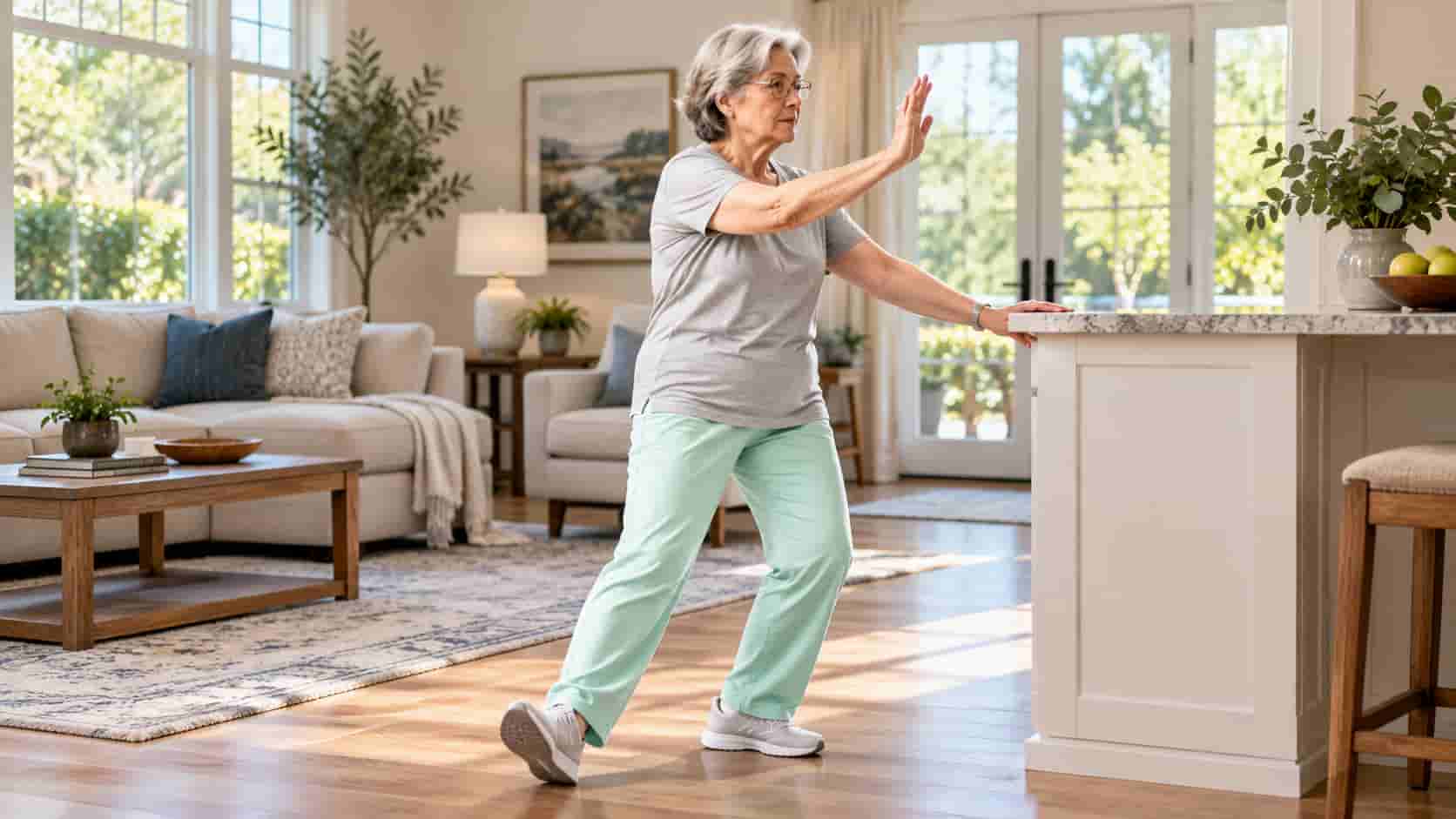
- Tai chi walking is a slow stepping practice based on the movement and weight-shifting principles of tai chi. You shift most of your weight onto one leg before the other foot steps, using a counter or chair for support if you need it.
- Five to ten minutes a day is a suggested starting point for older adults who can do the movements safely. If you have significant balance or mobility concerns, talk with your doctor or a physical therapist before you begin.
- One large review found that tai chi may lower the rate of falls by about 19%. It may also cut the number of people who fall by about 20%. That research looked at full tai chi classes, not short walking drills alone.
- Talk with your doctor first if you have fallen recently, feel dizzy, or have a heart or balance condition.
- The full routine is written out below, step by step, and a free printable version is also available to download and keep by your chair.
- Tai chi walking cannot promise to stop every fall. It does not cure arthritis. It is a gentle, low-cost option worth considering, alongside others, not a guaranteed fix.
Maybe your mom said she felt unsteady on the stairs last week. Maybe a friend told you tai chi changed how they move. Either way, you want a gentle way to stay active. You do not want something hard on sore knees or hips. Tai chi walking may be worth a try.
This guide explains what tai chi walking is. It shows how it differs from a normal walk. It also shows how it differs from a full tai chi class. You will learn how to try it safely, even if you are over 70. You will find the full routine written out, step by step, further down the page, along with a free printable version. There are also tips for family members who want to help a parent stay active.
This guide also explains what the research actually shows, including the parts that are still uncertain.
This article is for learning, not medical advice. Talk with your doctor or physical therapist first, especially if you have a health condition or a recent fall.
What Is Tai Chi Walking for Seniors?
Tai chi walking is a slow stepping practice built on the movement and weight-shifting principles of tai chi. It turns those principles into their own simple practice, separate from a full class. On a normal walk, you move quickly from one foot to the next. In tai chi walking, you slow way down. You shift most of your weight onto one leg first, using a counter or chair for support if that helps. Then you move the other foot forward, heel first. You roll your weight onto it slowly.
It sounds almost too simple to matter. But that slow weight shift practices the same kind of balance control your body relies on every day. Think about the last time you caught yourself before a stumble. Your body sensed where your weight was and fixed it fast. Tai chi walking practices that same skill on purpose. You do it in a safe spot, not by accident on a wet floor.
How Tai Chi Walking Works
Three things set tai chi walking apart from normal movement. First, you shift most of your weight onto one leg, using support if you need it, before the other foot lifts. Second, your heel touches down first on each step. Third, you breathe slowly and steadily the whole time. None of this is complex. The challenge, and the benefit, is doing it slowly on purpose. Moving this slowly also makes you pay closer attention to where your feet are and how your weight is moving. That's your body's built-in sense of its own position, sometimes called proprioception. Practicing that awareness on purpose is reasonable, though it hasn't been clinically tested in this specific short routine.
Tai Chi Walking vs. Regular Walking
Regular walking uses momentum. You push off one foot and let your body fall forward a little into the next step. Tai chi walking removes most of that push. You stay balanced on one leg for a moment first. Then the other foot moves. There is less "falling forward" into each step. That makes it slower and more controlled. That control is the whole point when you are working on balance.
Tai Chi Walking vs. Full Tai Chi
A full tai chi class uses many arm and hand movements. Think of moves like Cloud Hands or Brush Knee. These are usually linked into a longer sequence. Tai chi walking is just the stepping part. You practice it on its own. It is a gentle way to start if a full class feels like too much right now. Full programs often coordinate those arm movements with the same kind of stepping you're learning here. Once supported stepping feels comfortable, some readers choose to explore that fuller coordination with an experienced instructor. But tai chi walking on its own is not a stand-in for the complete practice. Most tai chi research studied full programs. It did not study walking drills by themselves. More on why that matters later in this guide.
Is Tai Chi Walking Safe for Seniors Over 70?
Tai chi walking may be a good fit for many older adults. It has low impact, it moves at a slow pace, and you can scale it back on a harder day. But it is not automatically right for everyone, exactly as written here. The right pace, step size, and amount of support depend on your own balance, mobility, and health. A little setup goes a long way.
Safety Checklist Before You Begin
- Clear your path of rugs, cords, pet toys, and clutter.
- Wear flat, closed-back shoes with some grip. Skip loose slippers and bare socks on hard floors.
- Practice in good light, especially if you exercise in the evening.
- Keep a sturdy chair, countertop, or wall within arm's reach.
- Keep your steps small and your pace slow. This is not a race.
- Breathe gently and naturally the whole time. Let your belly move with each breath instead of forcing a deep one, and never hold your breath. Some tai chi traditions focus on this kind of belly breathing, but comfortable, normal breathing is all this routine needs.
When to Use Support
Are you unsteady? Are you recovering from an illness or surgery? Are you simply trying tai chi walking for the first time? If so, rest one hand on a counter or a heavy chair for as long as you find it helpful. There's no required point at which you need to let go and practice unsupported. Steadiness matters more than speed.
When to Ask a Doctor or Physical Therapist First
Check with your doctor before you start if any of these apply to you:
- You have fallen once, or more than once, in the past year.
- You have ongoing trouble with balance or feel unsteady often.
- You get dizzy or feel faint, even sometimes.
- You have chest pain or odd shortness of breath.
- You have a history of stroke or Parkinson's disease.
- You had recent surgery or a joint replacement.
Are you unsteady on your feet? Then ask about a supervised balance class instead of starting alone. A physical therapist can check your own fall risk. A blog post never can.
Signs That Mean You Should Stop
There is a difference between ordinary effort and a warning sign.
- Stop and rest: you feel a little tired or slightly out of breath. Sit down, and try again later or another day.
- Stop and call your doctor soon: you feel dizzy, nauseous, or notice joint pain that does not ease once you sit down and rest.
- Stop and call 911 right away: you have chest pain or pressure, sudden severe trouble breathing, or sudden signs of a possible stroke, such as one side of the face drooping, weakness in one arm, or slurred speech. Do not wait to see if these pass.
One more safety note: this guide will not ask you to balance on one leg without support. That kind of test can cause a fall for someone already at risk.
How to Do Tai Chi Walking: Six Easy Steps
Try this near a counter or sturdy chair for as long as that helps you feel steady. Go slowly. You should be able to stop at any point without losing your balance.
- Stand tall and relax. Place your feet about hip-width apart. Soften your knees; do not lock them. Relax your shoulders. Look forward, not down at your feet.
- Shift your weight onto one leg. Let's say the left leg. Take your time. If you're holding a counter or chair, keep holding it. Let as much weight as feels safe settle into that leg before the other foot moves. You do not need to reach 100%, especially while you're still building confidence. In tai chi, the leg carrying most of your weight is sometimes called the "full" leg, and the other one the "empty" leg, simply because it feels lighter. You don't need to remember these words; they're just a way to notice the feeling.
- Step forward with the right foot, heel first. Keep the step short, shorter than you think you need. Your heel touches down lightly. Put no weight on it yet; this is your "empty" foot, free to move because it isn't holding you up.
- Roll your foot down slowly. Let the sole of your right foot settle onto the floor little by little, from heel to toe. Do not place it flat all at once.
- Shift your weight forward onto the right foot. Move slowly, using your support if you have it. You should feel your leg muscles doing the work, not momentum carrying you.
- Continue with the other foot. Your left foot is now light, resting just behind you. Lift it gently and step it forward, heel first, past your right foot, the same way you just did. Keep alternating feet like this, slowly, for as many steps as feels comfortable.
That is the whole pattern: shift, step, roll, shift, and continue with the other foot. There is a right way and a wrong way to do each part, which is why it's worth reading the common mistakes further down this guide. But there's no need to get it perfect on your first try.
Is Backward Tai Chi Walking Safe for Seniors?
Some tai chi classes include stepping backward as a more advanced variation. It isn't part of the routine in this guide, and it isn't a good unsupervised exercise for every older adult to try alone. Have you had a fall, or do you feel dizzy, or have neuropathy or other mobility limits? Then backward stepping is best left to a class or physical therapy session, where an instructor can watch your form and provide support. Mastering forward stepping first, the way this guide teaches it, is a reasonable place to stay for now.
A Free 5- to 10-Minute Tai Chi Walking Routine
You do not need a class, an app, or special gear to start. Here are two simple routines for a hallway, kitchen, or any clear stretch of floor: a short one and a slightly longer one.
| What to Do | 5-Minute Routine | 10-Minute Routine |
|---|
| Warm up: shoulder rolls, a gentle neck turn, a few slow breaths | 1 minute | 1 minute |
| Weight shifts in place (no stepping yet; hand on the counter if needed) | 1 minute | 2 minutes |
| The six-step walking pattern above (along a wall or counter if you're using support, so it stays within reach) | 2 minutes | 6 minutes |
| Cool down: stand or sit, hands resting gently on your middle, a few slow breaths | 1 minute | 1 minute |
These are suggested starting points, not a clinically tested treatment program. If even five minutes feels like a lot on a given day, rest when you need to and pick it back up tomorrow. No particular number of days or minutes can promise a specific result; the goal is simply steady, comfortable practice over time.
Everything you need to get started is written out above, so there's nothing you have to download. Want a simple one-page version to keep by your chair? Download the free Tai Chi Walking Guide (PDF). No email address is required.
Tai Chi Walking for Seniors With Limited Mobility
Maybe standing practice is not realistic for you right now. That does not rule you out. The same skills can be scaled to fit where you are today.
Supported Standing Practice
Keep one hand on a counter or a sturdy chair for the entire routine. Not just the first few tries, every time. There is no finish line that requires going hands-free.
Smaller Steps for Joint Discomfort
Do your knees or hips ache? Then shrink your step size even more. Skip any extra knee bend. A tiny, well-controlled step beats a bigger one that causes pain.
Seated Tai Chi-Inspired Alternatives
Sit in a sturdy chair with nothing in front of your legs. Shift your weight slowly from one hip to the other. "March" your feet slowly in place, heel first, just like you would standing. This is a different activity from standing tai chi walking, since your legs aren't bearing your weight the same way, so it does not train standing balance in the same way. What it can do is help you stay active, keep your legs moving, and practice the same slow, breath-led attention. If standing practice is possible for you, even briefly and with support, it is worth doing in addition to seated practice when you can.
When Professional Guidance Is Needed
Do you have real mobility limits? Do you have neuropathy, which means numbness in your feet? Have you fallen recently? Do you use a walker or wheelchair? If so, ask your doctor about physical therapy before you try this on your own. A home care aide can offer caring company and watch over a routine your doctor has approved. But a home care aide is not a stand-in for a physical therapist's gait or balance training.
What Does the Research Actually Show?
Tai chi has real research behind it. But most of that research studied full tai chi classes. Those classes often ran 30 to 90 minutes, two or three times a week, for months. They did not study short walking drills done alone for a few minutes a day. Keep that difference in mind as you read any claims about tai chi, including the ones in this guide.
Balance and Fall Risk
The National Center for Complementary and Integrative Health, or NCCIH, is part of the National Institutes of Health. NCCIH summarizes outside research on its website; it did not run this research itself. One 2019 review it summarizes looked at exercise for preventing falls in older adults who live independently, covering several different tai chi programs of varying length. It found two separate results. Tai chi may lower the overall rate of falls by about 19%, based on 7 studies and 2,655 people; this was rated low-certainty evidence. Tai chi may also reduce the number of people who have at least one fall by about 20%, based on 8 studies and 2,677 people; this was rated high-certainty evidence.
A separate 2017 meta-analysis pooled 10 trials with about 2,600 participants, ages 56 to 98. Most involved classes around an hour long, held one to three times a week, though not every trial was identical. Trials that tracked people for under a year found a bigger drop in the rate of falls, close to 43%. Trials that tracked people for a year or longer found a smaller drop, about 13%. This does not necessarily mean the benefit fades for any one person; it may simply reflect differences between the studies themselves. Either way, it shows these percentages can vary a lot depending on how a study is designed. Every number above describes full, instructor-led tai chi classes, not short walking drills practiced alone. Read NCCIH's full summary directly at the National Center for Complementary and Integrative Health.
Joint Comfort
NCCIH notes that tai chi may help with knee pain and stiffness from arthritis. The American College of Rheumatology recommends tai chi for knee and hip arthritis. That is good news. But it does not mean tai chi walking cures arthritis. It does not replace any treatment your doctor has already recommended.
Calm and Focus
Many people say tai chi feels calming. Slow, breath-led movement is a reasonable way to unwind. Research on mood and stress is encouraging, but it is still growing. This is best described as a likely bonus, not a guaranteed outcome.
What Hasn't Been Proven About Walking Drills Alone
Here is the honest gap. Very few studies have tested tai chi walking by itself, separate from a full class. That does not mean it does nothing; it uses the same weight-shifting and balance skills that full tai chi programs use. Direct research on this specific 5- to 10-minute home routine is limited. Here is what is known and what is not: full tai chi training appears to help balance and lower fall risk for many older adults in the studies above. It has not been established that a short daily walking drill on its own produces the same results. Until better research exists, tai chi walking is reasonably described as a low-risk way to practice a related skill, not as a proven substitute for a full program.
Common Tai Chi Walking Mistakes to Avoid
- Taking steps that are too big or fast. Smaller and slower is usually the safer choice while you're learning.
- Locking your knees. A soft bend the whole time can help protect your joints and support your balance.
- Holding your breath. Breathe slowly and naturally the entire time.
- Practicing while dizzy, in pain, or very tired. Rest instead. Try again later.
- Turning quickly. Turn using several small steps instead of pivoting on one foot.
Does a session feel rushed? That is a sign to slow down even more, not to push through.
Tai Chi Walking vs. Other Options for Older Adults
| Tai Chi Walking | Regular Walking | Full Tai Chi Class |
|---|
| Equipment | Supportive shoes; stable support (counter or chair) if needed | Supportive shoes | None, usually in a group |
| Joint impact | Very low | Low to moderate | Very low |
| Balance training | Involves controlled weight shifts and mindful stepping; independent research on this short routine is limited | Some, as a side effect | Studied more extensively; appears to help many older adults |
| Builds aerobic fitness | Minimal on its own | Yes, at a brisk pace | Modest |
| Good starting point for | Beginners wanting a gentle way to practice balance indoors | General daily activity | Those ready for a class or group setting. Anyone with significant fall risk should get an individual assessment first; a supervised or adapted program may be more appropriate than a general class |
The CDC has clear advice for adults 65 and older. Get aerobic activity each week. Get muscle-strengthening activity each week. Get balance activity each week, too. Tai chi walking is one reasonable way to work on the balance piece. It is not meant to replace your regular walks or strength work. It simply sits alongside them. See the full guidance at the CDC's physical activity guidelines for older adults.
Free Tai Chi Walking PDF, Videos, and Classes
Free Printable Guide
You can download the free Tai Chi Walking Guide (PDF) and print it in large text. No email address is required.
Free Beginner Video Lessons
For a video focused specifically on the stepping pattern in this guide, see Tai Chi Walking for Balance: Step-by-Step Beginner Tutorial by Dr. Paul Lam. It walks through the same mindful weight transfer and forward stepping covered above. Watching a movement is not the same as a clinical trial of it. Treat it as a helpful demonstration, not proof of a health outcome.
For a broader, full beginner tai chi sequence, the Tai Chi for Health Institute also offers a free introductory lesson from Dr. Lam. His programs are used in many senior centers and have been studied in published research. This one covers a full sequence rather than walking drills alone, a reasonable next step once the basics above feel comfortable.
Finding a Class Near You
Check your local senior center, community center, or Area Agency on Aging. Many offer a free or low-cost tai chi class, though this varies by area. Before you join, ask about the cost, the schedule, and whether the instructor has experience with older adults. According to Medicare.gov, Original Medicare (Parts A and B) does not cover gym memberships or fitness programs. Some Medicare Advantage and Medigap plans offer this as an extra benefit instead, which can include programs like SilverSneakers. This varies by plan; not every plan includes it. Call your plan directly to ask what it covers.
How to Choose an Instructor
Look for someone who has taught older adults before, not just tai chi in general. A good instructor will gladly explain changes for bad knees or balance worries. A good instructor will offer a seated option, too. They will not rush you through new movements.
Can Tai Chi Walking Help With Belly Fat or Weight Loss?
This question comes up a lot. Let's look at it honestly. One 12-week study, published in 2015, followed 374 middle-aged adults in Hong Kong. They were not seniors specifically. The exercise tested was not a short walking drill either; it was a full, structured tai chi program. The study compared that program with self-paced brisk walking (the exact term the study itself uses) and with a group that did neither. Both the tai chi group and the walking group lost a small amount of weight. That was about half a kilogram to three-quarters of a kilogram, or roughly one to one and a half pounds. Both groups also lost about 3.3 centimeters off their waist measurement on average. The group that did not exercise barely changed. Compared directly against that no-exercise group, the gap worked out to about 3.7 to 4.1 centimeters. Here is the key point: tai chi and walking produced almost the same results. Tai chi did not beat plain walking for weight loss in this study. You can read the study itself through the National Library of Medicine.
No form of exercise can target fat loss in just one spot on your body. Tai chi walking cannot do this either. If weight is part of your goal, tai chi walking can be one piece of an active routine. Pair it with regular walks, some strength work, and your usual eating habits. Do not expect it to work alone as a fix for belly fat.
How Family Caregivers Can Help Older Adults Stay Active
Make the Home Safer for Gentle Movement
Walk through your parent's home before any new routine starts. Look for loose rugs. Look for poor lighting. Look for cords across walkways. A few small fixes go a long way.
Help Build a Simple Daily Habit
Practice together, even for five minutes. This tends to work better than reminders shouted from across the room. It also lets you notice changes in balance or energy. Those changes are worth mentioning to a doctor.
When In-Home Help May Make Sense
Does your parent need company and gentle encouragement to stay consistent? Do they need help with other daily tasks, too? A home care aide can offer companionship and support for a doctor-approved routine. You can see how companion care and personal care services differ to get a sense of what's available.
Could You Be Paid to Care for a Family Member?
Are you already helping a parent with daily tasks and exercise like this? It is worth knowing that some state Medicaid and public home care programs let an eligible family member become a paid caregiver. This depends on your state, the specific program, your relative's eligibility, and a formal needs assessment. It does not happen automatically. Helping a parent practice tai chi walking by itself would not qualify someone for caregiver pay on its own. Cottage Home Care can help you understand what is available where you live. You can contact us to ask.
Frequently Asked Questions
Is tai chi walking safe for seniors over 70?+
It may be a good fit for many older adults, though the right pace and amount of support depend on your own health and balance. Start near a counter or sturdy chair. Keep your steps small. Check with your doctor first if you have fallen recently, feel dizzy, or have a heart condition.
How is tai chi walking different from a regular walk?+
Regular walking uses momentum to carry you from step to step. Tai chi walking removes most of that push. You shift most of your weight onto one leg, with support if you need it, before the other foot moves. This practices balance more directly.
How long should a beginner practice each day?+
Five to ten minutes a day is a good start. Some days a shorter practice is fine. Showing up regularly matters more than how long any one session lasts.
Can tai chi walking really help prevent falls?+
Research on full tai chi programs suggests it may lower fall rates in older adults. There is not strong direct research on short walking drills alone. No exercise can promise you will never fall. Think of it as one safe habit among several, alongside things like good lighting and clear floors.
Does Medicare cover tai chi classes?+
Original Medicare (Parts A and B) does not cover gym memberships or fitness classes, according to Medicare.gov. Some Medicare Advantage and Medigap plans offer this as an extra benefit, such as SilverSneakers, but not every plan includes it. Call your plan directly to check.
Can I do tai chi walking sitting down?+
A seated version is a reasonable option on a harder day: sit in a sturdy chair, shift your weight slowly from side to side, and march your feet in place, heel first. It is not the same as standing tai chi walking, since your legs aren't bearing weight the same way, but it can help you stay active. Ask your doctor or a physical therapist what's right for you if you have significant mobility limits.
Can tai chi walking be done with a walker or cane?+
It depends on your own balance, your mobility needs, and the type of walking aid you use. Not every cane or walker offers enough support for every stepping movement. Don't start a new stepping drill with your equipment on your own. Ask your doctor or a physical therapist first. They can tell you whether tai chi walking is a good fit for you and show you how to adapt it safely to your own equipment.
Is tai chi walking enough exercise on its own?+
The CDC says older adults need aerobic activity, muscle-strengthening activity, and balance activity each week. Tai chi walking is one reasonable way to work on the balance piece. It works best alongside regular walks and some strength exercise, not as a full replacement for both.
Getting Started Safely
Start small. Clear a path. Wear supportive shoes. Keep a counter or chair within reach. Try the six-step pattern for five minutes today, wherever feels steady. Does anything in your health history give you pause? A quick call to your doctor first is worth it.
Everything you need, the six steps and both routines, is written out earlier in this guide. Come back and follow along anytime, or print the free PDF version to keep nearby.
Is your family also thinking about daily support for a parent? Maybe that means help staying active. Maybe it means getting around safely at home, or simply having company. Either way, Cottage Home Care can talk through the in-home care options available in your area.


 Alex TullaoRegistered Nurse