Medicaid vs. Medicare: The Real Difference, Explained
Medicaid and Medicare sound almost the same. That is why so many people mix them up. But they are not the same. They are run in different ways. They pay for different things. They help different groups of people. If you mix them up, you might miss coverage you deserve. Or you might think a program will pay for something it will not.
This guide explains what each program is. It covers who can join, what each one pays for, and what happens if you qualify for both. Here is what you will read next:
What Is the Difference Between Medicaid and Medicare?
Quick answer:
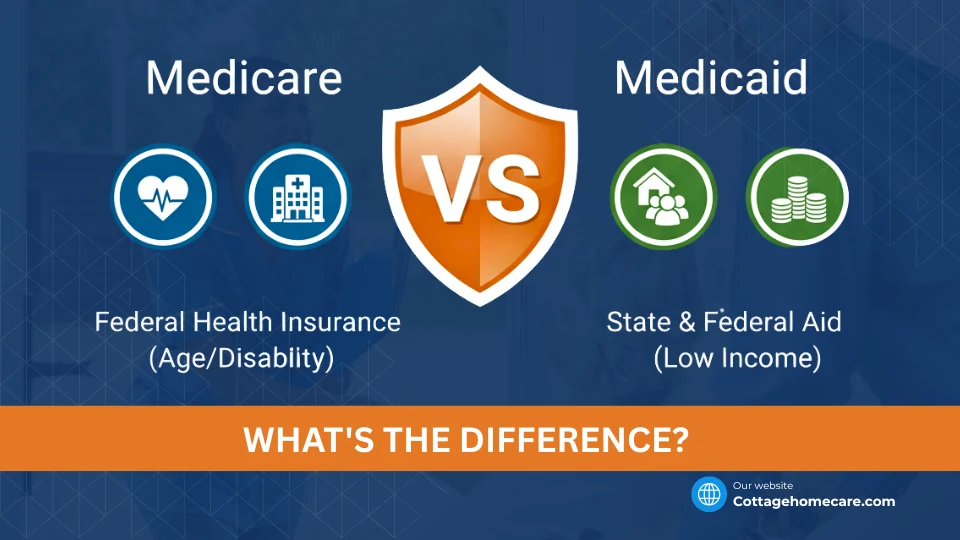
Medicare is federal health insurance. It is mainly for people 65 or older, or people with certain disabilities. It works the same way in every state. Medicaid is different. It is run by the federal government and each state together. It helps people with low income and few resources, of any age. The rules change from state to state. You can qualify for both programs at once.
Both programs started in 1965. Both are health insurance backed by the government. That is where the two programs stop being alike. The federal government runs Medicare on its own, through an agency called the Centers for Medicare & Medicaid Services (CMS). Your Medicare card works the same way in Ohio as it does in Oregon.
Medicaid works differently. The federal government sets basic rules. But each state runs its own version of the program. Each state decides who else can qualify. Each state sets its own income limits. This is why one person can qualify for Medicaid in one state, but not in another state, even with the same income.
The two programs also serve different groups by design:
-
Medicare is built around age and disability. Most people qualify at age 65. You can qualify earlier if you get Social Security Disability Insurance for 24 months. You can also qualify earlier if you have End-Stage Renal Disease or ALS.
-
Medicaid is built around financial need. It covers children, pregnant women, parents, adults with disabilities, and seniors with low income — anyone whose income and resources are under their state's limit.
Eligibility, Coverage, and Costs Compared
Quick answer:
Medicare eligibility depends on your age or a disability. It costs money — you pay premiums, deductibles, and coinsurance. Medicaid eligibility depends on your income and assets, and it is usually free or very low cost once you qualify. Medicaid also pays for long-term care, in-home care, and nursing home care that Medicare mostly does not. Some people qualify for both. This is called dual eligibility.
Here is how the two programs compare:
| Feature |
Medicare |
Medicaid |
| Run by |
Federal government (CMS) |
Federal government + your state |
| Who qualifies |
Age 65+, or under 65 with a qualifying disability, ALS, or ESRD |
Low income and limited resources, any age |
| Rules by state |
Same nationwide |
Different in each state, within federal rules |
| Core coverage |
Hospital stays (Part A), doctor visits (Part B), drugs (Part D), Medicare Advantage (Part C) |
Doctor visits, hospital care, and often long-term care, like nursing homes and home care |
| What you pay |
Premiums, deductibles, copays, coinsurance |
Usually free, or a small copay, depending on your state and income |
| When you enroll |
Set windows: Initial, Open, Special Enrollment |
Anytime you become eligible |
Medicare's four parts, briefly
- Part A pays for hospital stays. It is often free if you or your spouse paid Medicare taxes long enough.
- Part B pays for doctor visits and other outpatient care. You pay a monthly cost for it.
- Part C (Medicare Advantage) is sold by private insurance companies. It combines Part A, Part B, and often Part D. Many plans also add dental or vision care.
- Part D pays for prescription drugs. Private insurance companies sell these plans too.
Where Medicaid goes further
Medicaid's biggest advantage over Medicare is long-term care. Medicare will pay for a short stay in a nursing facility after a hospital stay, and for home health visits from a nurse or therapist, if a doctor says you need them. But Medicare usually will not pay for ongoing help with bathing, dressing, or cooking meals — the kind of help, called custodial care, that lets someone stay in their own home for a long time. Medicaid is different. Through state programs called waivers, or Home and Community-Based Services (HCBS), Medicaid pays for this kind of care in most states.
A common misconception worth clearing up: some people think Medicaid is only for people who do not work, or that you must choose Medicaid or Medicare, not both. Neither idea is true. Many working adults with modest income still qualify for Medicaid, and about 1 in 5 people on Medicare also has Medicaid.
Prescription drug coverage: Medicare Part D vs. Medicaid
Medicare's drug coverage comes from Part D, sold by private insurance companies as a standalone plan or bundled with a Medicare Advantage plan. Each plan has its own premium, deductible, and list of covered drugs (called a formulary). Because of this, two people on Medicare can pay very different prices for the same drug.
Medicaid handles drugs in a different way. Every state must cover a basic list of drugs, and most people on Medicaid pay nothing, or just a small copay, for each prescription. If you have both Medicare and Medicaid, Medicaid often covers drug costs that Part D does not, through a program called Extra Help. In short, people with both programs almost always pay less for drugs than people with Medicare alone.
Filling Medicare's gaps: Medigap and Medicare Advantage
Once people learn the basics, they often ask one more question: what else can help pay for what Medicare does not cover? There are two main answers, and you can only pick one.
-
Medigap (Medicare Supplement) is a private policy you buy along with Original Medicare. It helps pay leftover deductibles, copays, and coinsurance. The best time to buy it is during your 6-month Medigap Open Enrollment Period, which starts the month you turn 65 and have Part B — during that window, an insurer cannot turn you down for health reasons.
-
Medicare Advantage (Part C) replaces Original Medicare with a private plan that usually bundles hospital, medical, and drug coverage, often with extras like dental or vision care. It often costs less than Medigap, but you may have fewer doctors to choose from and more approval steps for certain care.
Most people choose one path or the other, not both — insurers do not sell Medigap policies to people who already have Medicare Advantage. If you also qualify for Medicaid, you probably do not need Medigap, since Medicaid already covers many of the same costs.
Medicaid expansion: why the same income qualifies in one state but not another
A law called the Affordable Care Act lets states expand Medicaid to cover more low-income adults, up to 138% of the Federal Poverty Level. By 2026, most states have done this, plus Washington, D.C. But a few states have not, including Florida, Texas, and Georgia (Georgia only has a limited version). In states that have not expanded, adults without children or a disability often cannot get Medicaid at all, no matter how low their income is. This gap is called the "coverage gap," and it's one big reason Medicaid can look so different for two people with the same paycheck.
What about CHIP?
The Children's Health Insurance Program (CHIP) often gets mixed up with Medicaid — it's easy to see why, since both are run by the federal government and the states together, and in most states the same agency runs both. But they help different groups. CHIP covers children, and in some states, pregnant women, in families who earn too much for Medicaid but not enough to easily pay for private insurance. If your income is a little too high for Medicaid, check CHIP before you give up — your kids may still have options.
Different states, different names
Because states run Medicaid, many give it their own name, which causes a lot of confusion for people looking for help. A few examples: California calls it Medi-Cal, Massachusetts calls it MassHealth, Tennessee calls it TennCare, and Wisconsin calls it BadgerCare Plus. Same program underneath, different name on the card.
When you qualify for both: dual eligibility
If you have both programs, you're called a "dual eligible." Medicare pays first for covered services, and Medicaid pays second, covering costs Medicare does not — like copays, deductibles, or long-term care. Depending on your income, you may also qualify for a Medicare Savings Program, like the Qualified Medicare Beneficiary (QMB) program, which helps pay your Medicare premiums and other costs.
Are you trying to find out if home care is covered? Read our separate guide to what Medicare and Medicaid pay for home care. Here's the short version: Medicaid usually helps pay for ongoing, non-medical home care, and Medicare usually does not — but there are some exceptions worth knowing.
Common Mistakes People Make
Quick answer:
The most common mistakes are thinking Medicare will pay for long-term home care, thinking Medicaid rules are the same in every state, and missing Medicare's enrollment window, which can cause a lasting late fee. You can avoid each of these with a little planning.
Mistake 1: Assuming Medicare covers long-term care.
This is the most costly mistake people make. Some families wait until a parent needs daily help before learning that Medicare will not pay for it over time. Medicaid usually will, but qualifying can take some planning — the earlier you plan, the more choices your family will have.
Mistake 2: Assuming Medicaid works the same in every state.
Two states can have very different income limits, different waiver programs, and different wait times for home-based care. Always check with your own state's Medicaid office.
Mistake 3: Missing the Medicare enrollment window.
Medicare's first enrollment period lasts seven months around your 65th birthday. If you miss it, and you have no other coverage, you may get a late penalty added to your premium — not a one-time fee, but an ongoing one.
Mistake 4: Not knowing about the Medicaid "spend-down."
In many states, you can still qualify with income a little too high. You do this by spending the extra amount on medical bills each month. Don't assume you're disqualified — you could be missing real help.
Mistake 5: Assuming Medicare premiums are the same for everyone.
People with higher income pay an extra charge on Part B and Part D called IRMAA, based on your tax return from two years ago. A one-time high-income year, like selling a home, can trigger this even if your income is much lower now.
Mistake 6: Assuming income alone decides Medicaid eligibility.
Ten states have not expanded Medicaid under the ACA. In these states, low-income adults without children or a disability often cannot qualify at all, no matter how little they earn. Check your state's expansion status first.
Best practice: Does your situation involve both aging and a limited income? If so, talk with a SHIP counselor or an elder law attorney first. SHIP stands for State Health Insurance Assistance Program. This counseling is free, and it can save you from costly guesswork.
Your Step-by-Step Action Checklist
Quick answer:
First, figure out which situation fits you: turning 65, having limited income, or both. Next, gather your documents. Then check your state's Medicaid rules, and apply through the right office — Medicare through Social Security, Medicaid through your state.
- Figure out your situation. Are you turning 65? Do you have a disability that qualifies? Is your income limited? Or some mix of these?
- Gather your papers. You'll need your Social Security number, proof of income, proof of where you live, and immigration or citizenship papers if they apply.
- Check your state's Medicaid income limits on your state Medicaid website or Medicaid.gov. Don't use a number you saw for a different state.
- Apply for Medicare through the Social Security Administration or Medicare.gov, within your enrollment window.
- Apply for Medicaid through your state's Medicaid office if your income and resources are under your state's limit — you can apply any time of year.
- Ask about long-term care and home care coverage, if that worries you. This is where Medicare and Medicaid differ the most.
- Watch for warning signs: a missed Medicare enrollment window, an ignored Medicaid renewal notice, or an unreported change in income or address.
What's changing: a federal law from 2025 is changing both programs over the next two years. Starting October 1, 2026, Medicaid rules get stricter based on immigration status. By January 1, 2027, most states will add work rules and will make people renew Medicaid every six months. Medicare is changing too — starting January 2027, people who aren't U.S. citizens or lawful permanent residents can no longer stay on Medicare, though people already enrolled as of July 2025 can usually keep coverage if they meet the other rules. Check Medicare.gov or your state Medicaid office for the newest rules, since some details are still being finalized.
Frequently Asked Questions
What is the main difference between Medicare and Medicaid?
+
Medicare is federal insurance based on age or disability, and it works the same in every state. Medicaid is a federal and state program based on income, and its rules change from state to state.
Can you have both Medicare and Medicaid at the same time?
+
Yes. This is called dual eligibility. Medicare pays first, and Medicaid covers many of the costs left over, including some services Medicare doesn't cover at all.
Does Medicaid or Medicare pay for home care?
+
Medicaid usually pays for ongoing, non-medical home care through state waiver programs. Medicare usually only pays for short-term home health visits that a doctor says you need, not ongoing custodial help.
Who qualifies for Medicaid vs. Medicare?
+
Medicare eligibility is based on turning 65, or having a qualifying disability, ALS, or End-Stage Renal Disease. Medicaid eligibility is based on income and resources under your state's limit, and it's open to people of any age.
Is Medicaid free?
+
For most people who qualify, Medicaid is free or very low cost. Some states charge small copays for certain services. Costs and rules are different in each state.
Does Medicare cover nursing home care?
+
Only for a short time after a hospital stay that qualifies, and only for skilled nursing, not custodial or long-term stays. Medicaid is the main payer for long-term nursing home care for people who qualify by income.
What happens if I lose Medicaid eligibility?
+
You should get a renewal notice from your state before your coverage ends. If your income or household changes, report it right away — gaps in coverage can be hard to fix once they happen.
Are there new Medicaid rules coming in 2026 and 2027?
+
Yes. Federal changes will roll out through January 2027, including stricter rules based on immigration status, more frequent renewals, and new work rules for many adults. Check Medicaid.gov or your state agency for the newest timeline.
What is CHIP, and is it the same as Medicaid?
+
No. CHIP covers kids, and sometimes pregnant women, in families that earn too much for Medicaid but still can't easily afford private coverage. CHIP is a separate program, though the same state agency often runs both.
What is Medigap, and do I need it?
+
Medigap is private insurance that pairs with Original Medicare to help pay leftover deductibles and coinsurance. It may be worth buying if you have Original Medicare and no other extra coverage. It's not sold to people with Medicare Advantage, and you likely don't need it if you already have Medicaid.
Does my state's Medicaid program go by a different name?
+
Often, yes. A few examples: Medi-Cal in California, MassHealth in Massachusetts, TennCare in Tennessee, and BadgerCare Plus in Wisconsin. It's the same federal and state program, just under a different name.
Will my Medicare premium go up if I earn more?
+
It can. People with higher income pay an extra charge on Part B and Part D called IRMAA, based on your income from two years ago. It comes from your tax return, not your current bank account, so a one-time high-income year can raise your cost for a while.
Is Medicaid eligibility the same in every state?
+
No. Income limits are different in each state, and ten states have not expanded Medicaid under the ACA. In those states, low-income adults without children or a disability may not qualify at all, no matter their income.
Will the 2027 changes affect Medicare eligibility for non-citizens too?
+
Yes. New federal rules starting in January 2027 will end Medicare eligibility for people who aren't U.S. citizens or lawful permanent residents, with some protection for those already enrolled by July 2025. Check Medicare.gov for the newest status, since guidance is still being worked out.
The Bottom Line
Medicare and Medicaid are not the same thing. They are two different safety nets, built for two different situations. Knowing which one, or both, applies to you really matters — it can mean the difference between getting help you deserve and missing it completely. If your family is trying to plan for aging-in-place or long-term care, that's usually where the two programs matter most, and it's best to get a clear answer before you need care, not after.
*This guide gives general information. It does not replace advice from Medicare.gov, Medicaid.gov, or your state Medicaid office, which can confirm the exact rules for your situation.*


 Alex TullaoRegistered Nurse