Home Care Packages Explained: Your
Options in NY, MD, NJ & MI
A plain-English guide to what a home
care package really means in the
United States, and how it works across
New York, Maryland, New Jersey, and
Michigan.
Have you started searching for a "home
care package"? You may have noticed the
search results are confusing. Some pages
talk about a government point system
with numbered levels. Other pages talk
about private agencies, Medicaid, or
paying out of pocket. This mix can leave
families more confused than when they
started.
Here is the short version. In the United
States, a home care package is not one
fixed government program. It is a mix of
services and funding that helps someone
stay safely at home instead of moving to
a facility. What this mix looks like
depends on where you live and how you
plan to pay for care.
This guide explains what a home care
package includes for families in New
York, Maryland, New Jersey, and
Michigan. It shows how the options
differ by state. It also covers what
they usually cost and how to pick a
provider you can trust.
What a Home Care Package Actually Means
in the US
Quick Answer:
A
home care package
is the group of in-home services,
staff, and funding a person uses to
stay safe at home. In the US, there is
no single program with fixed levels.
Families mix private pay, Medicaid
programs, and state waivers based on
their needs and where they live.
Some other countries use "home care
package" to mean a government program
with set funding tiers. If you have seen
mentions of numbered package levels or a
national aged care office, that is a
different country's system. It is not
how US Medicaid or private pay works. It
is an easy mix-up, since the phrase
shows up in many places online.
You may also see "care package" used for
something else: a box of gifts or snacks
sent to a college student or a family
member. That is a real and common use of
the phrase too. It is just not what this
guide is about. Here, "home care
package" means the services and funding
that help someone live at home.
In the US, a home care package usually
includes some mix of:
-
Personal care
— help with bathing, dressing,
grooming, and moving around
-
Skilled nursing
— help with medicine, wound care, and
health checks
-
Companion care
— friendly visits, meals, and daily
check-ins
-
Homemaker support
— light cleaning, laundry, and errands
-
Respite care
— a short break for the family member
who does most of the caregiving
-
Care coordination
— one person who tracks the plan and
updates it as needs change
The right mix depends on three things:
the person's health needs, what funding
they qualify for, and which state they
live in. Medicaid programs are run by
each state, so they vary quite a bit.
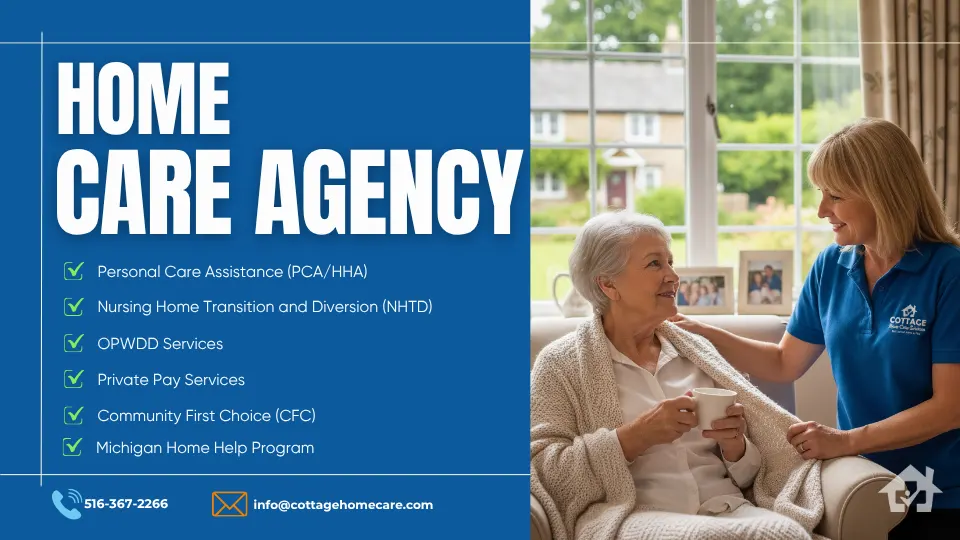
Cottage serves families through
HHA and PCA services in New York, the Community First Choice program in
Maryland, and Medicaid waiver programs
in Michigan.
The Programs Behind Home Care Packages,
State by State
Quick Answer:
Cottage Home Care works with several
funding paths depending on the state.
Private Pay
is offered everywhere. New York also
has
NHTD and OPWDD. Maryland has
Community First Choice. Michigan has
MI Choice, Home Help, and
PACE. Each program fits a different need.
No two families build their care plan
the same way. A parent recovering from
hip surgery in Rockville, Maryland needs
different care than someone with a
developmental disability in Queens. Here
is how the main options break down.
|
State
|
Common Programs
|
Who They're For
|
|
New York
|
Private Pay, NHTD, OPWDD, PCA/HHA
|
Seniors, people moving home from
a nursing facility, people with
developmental disabilities
|
|
Maryland
|
Community First Choice
(CFC), Private Pay
|
People on Medicaid with
disabilities who want to stay in
their community
|
|
New Jersey
|
Private Pay
|
Families who want full control
over caregiver choice, schedule,
and services
|
|
Michigan
|
MI Choice Waiver, Home Help,
PACE
|
Seniors and adults with
disabilities who qualify for
Medicaid waivers
|
Nursing Home Transition and Diversion
(NHTD)
is a New York program. It helps someone
move from a nursing facility back home,
or helps them avoid that move in the
first place. A team of aides and nurses
supports the change.
OPWDD services give long-term support to
people with developmental disabilities.
It focuses on independence. It helps
people stay part of their community. It
is more than just help with daily tasks.
Community First Choice (CFC)
is a Maryland Medicaid program. It pays
for personal care and support. This
helps people with disabilities stay in
their own homes instead of a facility.
MI Choice, Home Help, and
PACE
are Michigan's main Medicaid programs
for home-based care. Each one has its
own rules, but all three aim to keep
people safely out of a nursing facility.
Private Pay
is offered in every state Cottage
serves. Families who do not qualify for
Medicaid, or who want more say over
scheduling and caregiver choice, often
start here. There is no waitlist and no
approval process. You simply build a
care plan around what your family needs.
What a Home Care Package Typically Costs
National surveys, like Genworth's Cost
of Care report, put the median hourly
rate for non-medical home care at about
$27 to $30 an hour in recent years. Your
real cost depends on your state, the
hours you need, and whether skilled
nursing is involved. Medicaid programs
like CFC and MI Choice cover eligible
services at no direct cost to the
family. Private pay is billed by the
hour or by care plan. A care coordinator
can give you an exact estimate once they
review your needs.
Other Ways to Pay Beyond Medicaid and
Private Pay
Medicaid and private pay are not the
only two options. Depending on your
loved one's background and current
coverage, these are worth asking about:
VA Aid & Attendance
benefits
— an extra monthly benefit for
eligible wartime veterans and
surviving spouses who need help with
daily activities. It comes on top of
a standard VA pension.
Long-term care insurance
— if your loved one already has a
policy, it may cover part or all of
a home care package. Check the daily
benefit amount and waiting period
first.
Life Care Funding
— some families convert an existing
life insurance policy into funds for
current care needs. Talk to a
financial advisor before you rule
this out.
A care coordinator can help you figure
out which of these fits your situation.
The rules are different for each one.
Common Misconceptions About Home Care
Packages
"There are only 4 fixed package levels."
That idea comes from a different
country's aged care system. US home care
does not work that way. Your plan is
built around your own needs and what
funding you qualify for.
"Medicaid pays for all home care
everywhere." Coverage depends on which
program you qualify for and which state
you live in. Some services are fully
covered. Others need private pay or a
mix of both.
"You have to pick one program and stick
with it." Plans can change. If your
needs grow or your funding changes, your
care coordinator can adjust the mix of
services.
Not sure which option fits your
family?
A short talk with a care coordinator
is often faster than trying to figure
it out from state websites and forums.
We will walk through your loved one's
needs and tell you, honestly, which
programs you likely qualify for, even
if it is not with us.
Schedule a free home care
consultation
Common Mistakes Families Make When
Choosing a Home Care Package
Quick Answer:
Families make
three mistakes
most often. They assume Medicaid
covers everything. They wait for a
crisis before they plan ahead. They
pick a provider based on price alone,
without checking the license or nurse
oversight.
MISTAKE 1
Assuming eligibility instead of
checking it.
Programs like CFC and MI Choice have
rules about income, assets, and the
level of care someone needs.
Applying without checking first can
cost you weeks of delay.
MISTAKE 2
Waiting for a crisis.
Many families start looking into
home care packages right after a
fall or a hospital stay, when there
is no time to spare. Starting your
research a few weeks earlier gives
you more options and less stress.
MISTAKE 3
Choosing based on price
alone.
A lower hourly rate does not help
much if the agency has no licensed
oversight, no background checks on
staff, or no backup plan when a
caregiver is out sick.
MISTAKE 4
Not asking about the transition
plan.
If your loved one is moving home
from a nursing facility, ask the
agency exactly how they handle that
move, not just day-to-day care
after.
Best practice:
Before you sign with any provider, ask
three things: is the agency licensed
by the state, does a registered nurse
oversee the care plan, and what
happens when a caregiver calls out
sick? These three questions catch most
of the risk.
Does your loved one have a serious
health condition? Have they had a recent
hospital stay, or signs of memory loss?
If so, talk to their doctor or a
hospital discharge planner too. Do not
rely on the home care agency alone.
Your Step-by-Step Checklist for Getting
Started
Quick Answer:
Start by
listing your loved one's daily
needs. Then check Medicaid or program
rules, gather your key documents, and
set up a free call to compare
providers before you decide.
1
List daily needs first.
Write down what is hard right now:
bathing, taking medicine on time,
meals, moving around, feeling
lonely. This list becomes the base
of the care plan.
3
Gather your documents.
Have Medicaid or insurance
information, a list of current
medicines, and any recent hospital
paperwork ready.
4
Ask about caregiver
matching.
A good provider asks about
personality and daily routine, not
just medical needs.
Warning signs to watch for:
caregivers who miss visits often, no
registered nurse on the care team, or
a provider who cannot explain what
your funding covers. Any of these is a
reason to keep looking.
Frequently Asked Questions
What is a home care package?+
It is a mix of in-home services and
funding, like private pay, Medicaid,
or state waiver programs, that helps
someone live safely at home instead
of in a facility.
Is a home care package the same as a
nursing home alternative?+
Often, yes. Programs like NHTD are
built to help someone avoid, or
leave, nursing home care while still
getting medical support at home.
Does Medicare cover home care
packages?+
Medicare covers some skilled home
health care for a short time. It
does not usually cover long-term
personal care or housekeeping help.
How much does a home care package
cost per month?+
It depends on the hours you need and
how you pay. Medicaid-covered
programs may cost little or nothing
out of pocket. Private pay is
usually billed by the hour, often in
the high-$20s to low-$30s range.
Can I choose my own caregiver?+
With private pay, and with some
Medicaid programs, yes. Ask your
provider directly, since this
depends on your funding source.
What's the difference between CHHA
and private pay services?+
A CHHA (Certified Home Health
Agency) gives skilled, medically
supervised care. Private pay is more
flexible and does not require a
medical need to start.
How do I find home care package
providers near me?+
Search by state, since programs and
rules are different in each one.
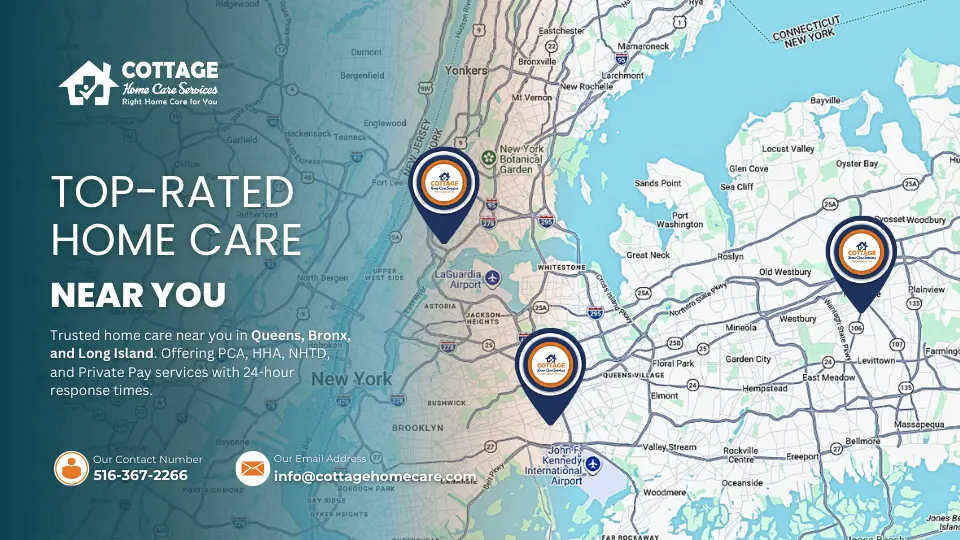
Cottage Home Care serves
New York,
Maryland, New Jersey, and
Michigan
directly.
Can a home care package include help
after surgery?+
Yes. Help after surgery is one of
the most common reasons families
start a home care package. This
often comes through
private pay
or CHHA services.
How do I apply for a home care
package?+
It starts with an eligibility check
and a review of your needs. For
Medicaid programs like CFC or MI
Choice, your care coordinator or
state Medicaid office walks you
through sign-up. Private pay has no
application process.
Does a home care package cover
respite care?+
Yes. Many packages include
short-term respite care. This gives
a family caregiver time to rest,
travel, or handle other tasks.
Will VA benefits or long-term care
insurance help pay for home
care?+
Often, yes. VA Aid & Attendance
helps eligible veterans and spouses.
Many long-term care insurance
policies also cover home care hours.
Check your policy or VA eligibility
to be sure.
Choosing the Right Home Care Package for
Your Family
There is no single "right" home care
package. The right one is the mix of
services and funding that fits your
loved one's needs, your state's
programs, and your family's situation
right now. The real mistake is not
picking the wrong program. It is waiting
too long to ask, or assuming the
internet's version of "home care package
levels" applies to your state, when it
likely does not.
Not sure whether NHTD, OPWDD, CFC, MI
Choice, or private pay fits your
situation? That is the exact
conversation our care coordinators have
every day.
Contact our care team for a free home
care consultation. We will walk you through your options
honestly, even the ones we do not offer.


 Alex TullaoRegistered Nurse