What Is a Home Health Care Aide? Duties, Cost, and How to Get Started
Trying to figure out if your mom or dad needs a home health care aide, a personal care aide, or something else? You’re not alone. The terms get used interchangeably online. Most of what comes up in a search is written for people trying to become an aide, not for families trying to hire one.
This guide is written for the second group. We’ll cover what a home health care aide actually does, how the role differs from a personal care aide or a CNA, what it costs, and how Medicaid, Medicare, and VA benefits fit into the picture. We’ll also flag something most guides skip entirely: the rules here change by state, sometimes a lot.
In This Article
What a Home Health Care Aide Is
Quick Answer
A home health care aide (HHA) is a trained caregiver who helps people with daily living tasks in their own home. This includes bathing, dressing, and mobility. An HHA can also handle some health-related duties, like checking vital signs or giving medication reminders, under a nurse’s supervision. HHAs typically work for a licensed home care or home health agency. They complete state-required training before working with a client.
That short answer covers most of what people search for. It’s worth breaking down a bit further.
Why the “home health” part matters
The word “health” in the title isn’t decorative. It’s the line that separates a home health care aide from a general caregiver. A caregiver, in the everyday sense, might be a family member or a friend helping out, usually with no formal training. A home health care aide is different.
Federal rules for Medicare-certified agencies (42 CFR 484.80) set a floor of at least 75 hours of combined classroom and supervised clinical training, including at least 16 classroom hours before at least 16 hours of hands-on clinical practice, plus 12 hours of continuing education every year after that. States can require more, and many do. California requires up to 120 hours of training for aides who aren’t already certified nursing assistants. Maine requires 180 hours, including 70 in a clinical setting, the highest training requirement in the country. That range is exactly why the answer to “how long is HHA training” depends entirely on where you’re asking.
Who oversees the work
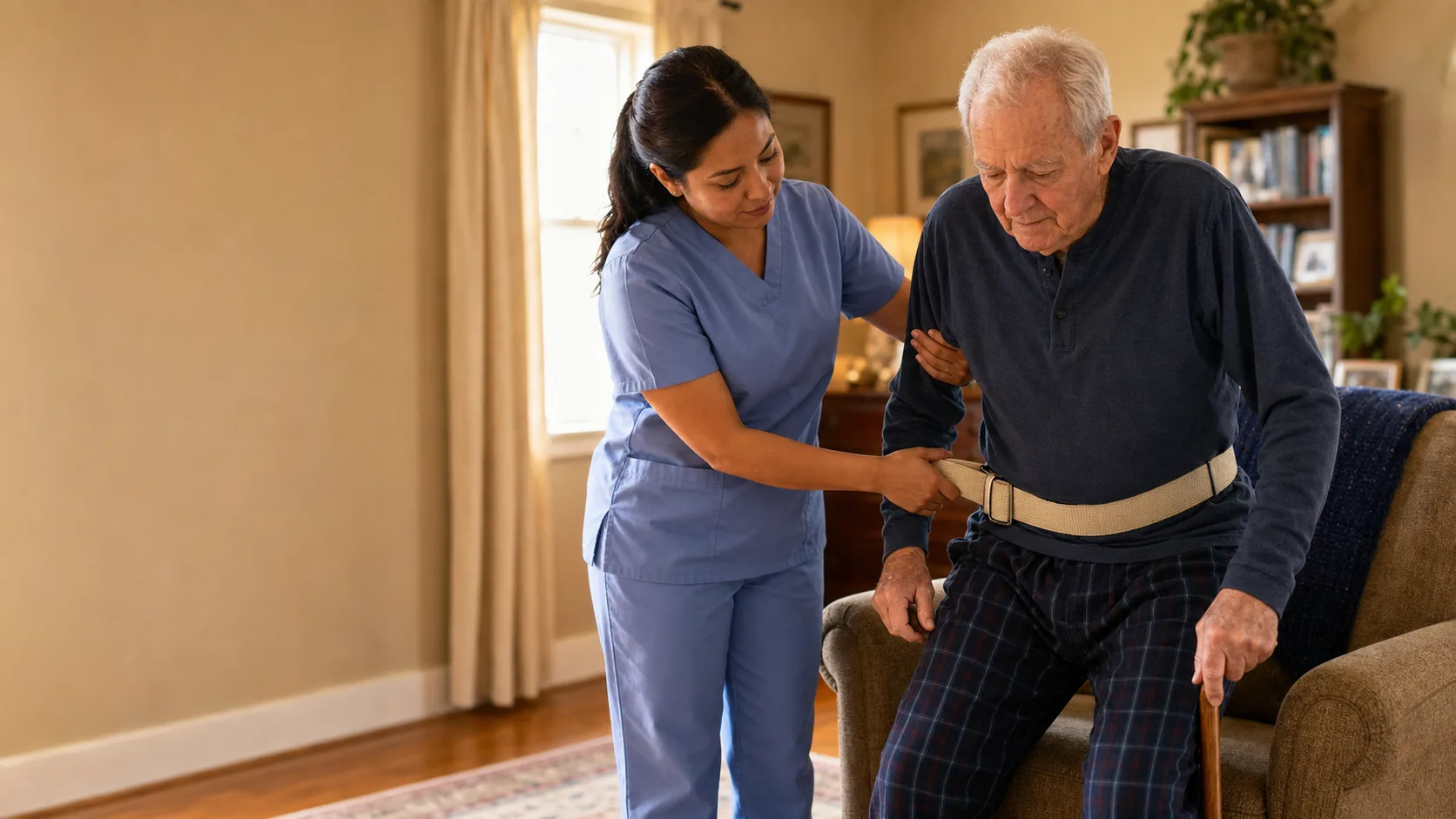
Home health care aides don’t work alone. A registered nurse or care coordinator usually builds the care plan first. The aide then follows that plan. This supervision is what allows an HHA to do slightly more than a personal care aide. For example, an HHA might take a temperature or remind a client to take medication at the right time. It’s also why families should expect regular check-ins from an agency. A caregiver who shows up and improvises with no oversight is a warning sign, not a good fit.
This isn’t a new idea, either. Visiting Nurse Associations began organizing nurse-supervised home care in American cities in the late 1800s. The same basic structure, a nurse building the plan and an aide carrying it out, is what federal regulation later formalized into the system described above.
What this looks like for an actual family
Picture a fairly ordinary week. Dad fell in the bathroom ten days ago. Nothing broken, but everyone’s nerves are still raw, and the calls have gone from once a day to three times, mostly just to hear his voice answer. Sleep has gotten worse. So has the quiet math of how many more times a week you can leave work early.
That’s usually the moment people start searching “home health care aide,” not idle curiosity. Once a trained aide is actually in the home, families tell us the biggest change isn’t the bathing schedule or the medication reminders, real as those are. It’s that the 9 p.m. phone call stops feeling like a threat and goes back to being just a phone call. The logistics below matter, but that shift is usually the point.
How it’s different from three similar-sounding roles
People searching for “home health care aide” are almost always comparing it to three other terms. At a glance:
- HHA: state-trained (75-hour federal floor, more in some states), can do light health-related tasks under nurse supervision, works through a licensed agency. Non-medical caregiver baseline rates range from $18–$21 per hour, with Cottage Home Care offering top-tier, state-leading compensation based on experience.
- PCA: little to no required training, helps with bathing and daily tasks, no health monitoring.
- CNA: longer clinical training, often facility-based, broader clinical scope.
- Family caregiver: usually untrained and unpaid unless a specific state program applies.
Here’s the fuller breakdown.
Home Health Aide (HHA)
Typical Training
Federal floor of 75 hours (42 CFR 484.80); many states require more, up to 180 hours in Maine
Can Help With
Bathing, dressing, mobility, plus vital signs and medication reminders under nurse supervision
Usually Works
In the client’s home, through a licensed agency
Personal Care Aide / PCA
Typical Training
Little to no state-mandated training in most states
Can Help With
Bathing, dressing, grooming, light housekeeping, meal prep
Usually Works
In the client’s home
Certified Nursing Assistant (CNA)
Typical Training
Longer, more clinical program, often 75 to 160 hours, plus a state exam
Can Help With
Everything a PCA does, plus more hands-on clinical tasks under a nurse’s direction
Usually Works
Often in nursing homes or hospitals, though some work in-home
Family Caregiver / Informal Caregiver
Typical Training
Usually none, unless enrolled in a specific state consumer-directed program
Can Help With
Whatever the family arranges
Usually Works
In the client’s own home
Cottage Home Care offers both personal care and home health aide support. Families don’t need to figure out which box their loved one fits into before they call. Our team sorts that out during a free care assessment.
Where home health aides work, and who they support
Most home health aides care for clients in private residences, but that’s not the only setting. Depending on state rules and the specific placement, HHAs also provide one-on-one support in assisted living communities, adult day programs, and group home settings for people with developmental disabilities. Cottage Home Care’s own aides are trained to work across these settings, not just single-family homes, whether that’s a private house, a high-rise apartment, or an assisted living community. If a group home or OPWDD-supported setting is what your family needs, our guide to group home care in New York covers that specific path.
The reasons people bring in a home health aide go well beyond general aging, too. Beyond recovery from a fall, HHAs commonly support:
- Recovery after surgery, a joint replacement, or a stroke
- Progressive neurological conditions such as Parkinson’s disease, ALS, or multiple sclerosis
- Alzheimer’s disease and other forms of dementia
- Developmental or physical disabilities that require ongoing daily living support
The specific condition matters less than the specific tasks it creates. A stroke survivor relearning mobility and a person managing later-stage Parkinson’s need different things from an aide, even though both fall under the same job title. This is exactly what a care assessment is for.
Rules Vary by State
Quick Answer
Medicaid coverage, consumer-directed family caregiver programs, and what a home health aide is legally allowed to do all vary by state, sometimes significantly. A rule that applies in New York may not apply in Pennsylvania or Indiana. Always confirm your specific state’s requirements rather than assuming the details above apply everywhere.
This is the part most guides skip, and it’s the part that actually changes what your family should expect.
- Medicaid waiver programs differ by state. Some states cover HHA services broadly, some cap hours, and some run separate waiver programs with their own waitlists.
- Consumer-directed caregiver programs vary too. Whether a family member can be trained and paid as a caregiver, and under what program name, depends entirely on the state.
- Scope of practice isn’t uniform. What an HHA is permitted to do under nurse supervision in one state may require a different certification level in another.
- Training hours vary, as shown above. A 75-hour-trained aide and a 180-hour-trained aide are both legally “home health aides,” just certified under different state floors.
Before you assume anything is covered: check your specific state’s Medicaid waiver rules and HHA scope-of-practice regulations before budgeting or making care decisions. If you’re in one of Cottage Home Care’s licensed states, a local advisor can walk you through what actually applies where you live rather than what’s generally true nationally.
Veterans and VA Home Health Aide Benefits
Quick Answer
The VA’s Homemaker and Home Health Aide Care (H/HHA) program provides in-home aide visits to eligible veterans enrolled in VA health care, under a doctor-approved care plan and RN oversight. Depending on eligibility and priority group, the cost to the veteran can be low or none. It’s separate from Medicaid and Medicare, and can sometimes be used alongside either.
This program deserves more attention than it usually gets, given how many people searching this topic are military families.
To use it, a veteran generally needs to already be enrolled in VA health care, have a documented need for help with personal care due to a health condition, and have a care plan developed with a VA provider. Once approved, a home health aide visits under essentially the same RN-supervised model described earlier in this article. Services typically include personal care, light housekeeping, and companionship.
One detail worth knowing: the H/HHA program explicitly recognizes that it’s also for the veteran’s family caregiver, not just the veteran. If you’re the one providing most of the day-to-day care for a veteran, this program’s respite function is worth asking about before you look at the cost of hiring an aide privately.
If you’re exploring this option, ask any agency you’re considering, including Cottage Home Care, whether they participate in the VA’s community care network in your state.
What a Home Health Care Aide Actually Does
Quick Answer
Day to day, a home health care aide helps with bathing, dressing, grooming, meal preparation, light housekeeping, mobility, and companionship. Depending on the state and the client’s care plan, they may also monitor vital signs, remind a client to take medication, and report any changes in condition to a supervising nurse.
Here’s what that looks like across a typical week.
Personal care tasks
- Bathing, showering, or bed baths
- Dressing and grooming
- Toileting and incontinence care
- Help moving safely between bed, chair, and wheelchair, including the use of gait belts or mechanical lifts when the care plan calls for it
- Calm, redirection-based support for clients with Alzheimer’s or dementia, rather than correction or argument
Household support
- Light cleaning, laundry, and dish washing
- Meal planning and preparation around dietary needs
- Grocery shopping or arranging transportation to appointments
Health-related support (with nurse oversight, and subject to state rules)
- Checking and recording pulse, temperature, or blood pressure
- Reminding a client to take prescribed medication
- Watching for and reporting changes in a client’s condition
- Following basic infection prevention practices, like handwashing and safe use of gloves, to reduce the spread of illness in the home
- Keeping a simple daily record for the supervising nurse, covering things like meals eaten, fluids taken, sleep, and mood
Infection control and daily observation and reporting aren’t optional extras. Both are named directly in the federal training standard mentioned earlier (42 CFR 484.80), which is why every certified aide, regardless of which state trained them, has covered this material.
What a home health care aide does not do
- Administer medication directly. In most states, reminding is allowed, but injecting or administering it is not.
- Diagnose a condition or change a care plan.
- Perform skilled nursing tasks like wound care or IV management without extra certification and direct RN involvement.
That last list matters more than people expect. Many families assume “health aide” means the same clinical scope as a nurse. It doesn’t. Knowing the boundary up front avoids a frustrating conversation later, and knowing it can shift by state avoids an even more frustrating one.
A common misconception worth clearing up
Many people assume Medicare automatically pays for ongoing, day-to-day home health aide visits. It generally doesn’t. Medicare’s home health benefit covers skilled, doctor-ordered care, like nursing visits or physical therapy, for a defined period. This is usually tied to recovery from a hospital stay or a medical event. Once that skilled need ends, Medicare coverage for aide visits usually ends too. Continuing, long-term help with daily living is typically paid for through Medicaid (for those who may qualify, subject to your state’s waiver rules), VA benefits for eligible veterans, long-term care insurance, or private pay.
If long-term care insurance is part of your plan, know that most tax-qualified policies only start paying once a specific benefit trigger is met, typically needing hands-on help with at least two of six activities of daily living (like bathing or transferring) for an expected 90 days or more, or a documented severe cognitive impairment. There’s usually an elimination period, often 30 to 90 days, between when that trigger happens and when payments actually begin. Your specific policy language controls here, so it’s worth reading before you assume coverage will apply.
Respite isn’t a side benefit
Caregiver burnout is well documented in caregiving research: chronic stress, disrupted sleep, and health decline are common among people caring for a loved one without support. A home health care aide’s visits do double duty here. They’re not just care for your loved one. They’re also respite for you, the person who’s been holding this together. If ongoing caregiver stress is part of what brought you to this article, our guide to family caregiver support programs covers options beyond hiring an aide, including support groups and paid family caregiver programs.
How much does a home health care aide cost?
While national private-pay agency billing medians hover around $34 an hour, non-medical caregiver baseline rates range from $18–$21 per hour, with Cottage Home Care Services offering top-tier, state-leading compensation based on caregiver experience and state guidelines. This varies by state and whether care is hourly or live-in. Agencies typically charge somewhat more than hiring someone independently. That difference reflects the cost of background checks, training, supervision, and having a backup caregiver ready if your regular aide is out sick, a tradeoff covered in more detail in the next section.
Care doesn’t have to mean the same schedule for everyone, either. Depending on what your family needs, visits can range from a few short hours a day, to overnight shifts, to split coverage across the clock, to a live-in arrangement where the aide stays in the home. Live-in and 24/7 care are usually billed differently than hourly visits. In New Jersey, for example, Cottage Home Care’s live-in rates are typically billed daily rather than hourly. Ask any agency you’re considering how they structure and bill for round-the-clock care before assuming it’s just your hourly rate multiplied out.
While the national number is a useful benchmark, local pricing and Medicaid rules are what actually matter for your budget. If you’re in New York or New Jersey, our state pages break down HHA services and coverage in New York and Medicaid and private-pay rates in New Jersey in more detail.
Not sure whether your family may qualify for Medicaid-covered care, or whether private pay makes more sense? Talk to a Cottage Home Care advisor. There’s no cost or obligation to ask.
Agency or Independent Hire?
Quick Answer
Hiring an aide through a licensed agency shifts legal and financial responsibilities, like payroll tax withholding, workers’ compensation, and backup coverage, onto the agency. Hiring someone directly can cost less per hour on paper, but it makes your family the legal employer, with real tax and liability obligations attached.
This is a decision families often don’t realize they’ve made until after they’ve made it.
If you pay a caregiver directly and control how and when they work, the IRS generally considers you a household employer, not a customer. Paying any one household employee above the annual IRS threshold triggers Social Security and Medicare tax withholding, commonly called the “nanny tax,” reported on Schedule H with your federal tax return. Skipping this isn’t a shortcut. It’s a liability that tends to surface later, sometimes at the worst possible time.
There’s also the coverage gap. If your independent caregiver gets sick, takes time off, or doesn’t show up, there’s often no backup unless you’ve arranged one yourself. And if that caregiver is injured in your home, your homeowner’s insurance may not cover it the way a workers’ compensation policy would, depending on your state and your policy.
None of this means independent hiring is the wrong choice for every family. Some people manage it well, especially with an accountant or elder law attorney involved from the start. But it’s worth going in with your eyes open. An agency like Cottage Home Care carries the payroll tax, workers’ compensation, and backup-coverage responsibilities as the employer of record. That’s part of what the higher hourly rate is actually paying for.
Common Mistakes Families Make When Hiring an Aide
Quick Answer
The most common mistakes are assuming Medicare will cover ongoing care, assuming rules from a different state apply locally, underestimating the tax and liability exposure of hiring independently, skipping questions about background checks and supervision, waiting until a crisis to start looking, and not clarifying up front which tasks the aide can and can’t perform.
- Assuming Medicare covers day-to-day help. As covered above, Medicare is built around short-term, skilled, doctor-ordered care. It isn’t built for indefinite daily support. Confirm your actual payment path before care starts. It saves you an unpleasant surprise on the first bill.
- Assuming your neighbor’s state rules apply to you. A friend in another state describing what Medicaid covered for their parent is not a reliable guide to what’s covered where you live. Confirm your own state’s rules directly.
- Not asking who supervises the aide. A home health care aide working with no nurse oversight is a warning sign. Ask who builds the care plan. Ask how often a supervisor checks in. Ask what happens if your loved one’s needs change.
- Skipping the background check question. A licensed agency should tell you, without hesitation, what its screening process looks like. If an agency is vague about this, notice that.
- Waiting for a crisis. Families often start looking for help right after a fall, a hospital discharge, or a diagnosis. Setting up care before an emergency, even just having an assessment done, tends to lead to a smoother transition. It also gives you more choice in who provides the care.
- Not clarifying scope in writing. Get the specific tasks, schedule, and cost structure in writing before care begins. It protects everyone involved, including the aide.
How to Get Started: A Step-by-Step Checklist
Quick Answer
Start by listing the specific tasks your loved one needs help with. Then check your state’s Medicaid, Medicare, VA, or private-pay options, since coverage varies by state and by eligibility. Then contact a licensed agency for a free assessment before committing to a schedule.
- List out the actual daily struggles. Is it bathing safely? Remembering medication? Getting to appointments? Being specific helps an agency match the right level of aide.
- Check your coverage path, state by state. Ask whether your loved one has Medicaid, Medicare, or VA health care enrollment. Each covers different things, and the specific rules, including waiver programs and hour caps, depend on your state.
- Decide between an agency and an independent hire. Weigh the tax, liability, and backup-coverage tradeoffs covered above before deciding based on hourly rate alone.
- Ask a licensed agency for a free care assessment. A short in-home or phone assessment should tell you what level of support fits and roughly what it will cost.
- Ask about caregiver matching. Language, cultural background, and personality fit all affect how care actually goes. A good agency will ask about this, not just assign whoever’s available.
- Get the care plan in writing before the first visit, including hours, tasks, and cost.
- Plan for continuity. Ask what happens if your regular aide is sick or unavailable. A one-person plan isn’t really a plan.
Cottage Home Care has been arranging in-home care since 2019. Our care advisors walk through each of these steps with families as part of a free consultation, and can explain exactly how your state’s rules apply, whether the right fit ends up being personal care, home health care, or a private-pay arrangement.
Frequently Asked Questions
What is a home health care aide?
+
A home health care aide is a trained, agency-supervised caregiver who helps with daily living tasks like bathing and dressing. They can also handle basic health-related tasks, like vital sign checks, under a nurse’s oversight.
What does a home health care aide do all day?
+
Typical duties include bathing, dressing, mobility support, light housekeeping, meal prep, medication reminders, and watching for changes in a client’s condition to report to a supervisor.
How many hours of training does a home health aide need?
+
Federal rules require at least 75 hours for aides working through Medicare-certified agencies. States can require more. California requires up to 120 hours, and Maine requires 180, the highest in the country.
What is the difference between a home health aide and a personal care aide?
+
A personal care aide focuses on daily living tasks like bathing and dressing. A home health aide has extra training and can also handle basic health-related duties, like medication reminders, under nurse supervision.
What is the difference between a home health aide and a CNA?
+
CNAs generally complete longer, more clinical training. They often work in nursing homes or hospitals. Home health aides typically have shorter training and work only in private homes.
What is the difference between a home health aide and a family caregiver?
+
A family caregiver is usually unpaid and untrained, unless enrolled in a specific state program. A home health aide is trained, background-checked, and supervised through a licensed agency.
Do home health aide rules differ by state?
+
Yes. Medicaid coverage, consumer-directed caregiver programs, training hours, and what an HHA is allowed to do under supervision all vary by state. Confirm your specific state’s rules rather than assuming they match another state.
Does Medicaid cover home health care aide services?
+
In most states, Medicaid covers personal care and home health aide services for people who meet income and care-need requirements. Coverage rules vary by state, so confirm your specific situation.
Does Medicare cover home health care aide services?
+
Medicare generally covers short-term, doctor-ordered aide visits tied to a specific medical need, like recovery after a hospital stay. It typically does not cover ongoing, long-term daily support.
Does the VA cover home health aide care for veterans?
+
In many cases, yes. The VA’s Homemaker and Home Health Aide Care program provides aide visits to eligible veterans enrolled in VA health care, often at little or no cost depending on eligibility. Confirm your specific situation with the VA or a local agency.
How much do non-medical caregivers earn?
+
Non-medical caregiver baseline wages range from $18–$21 per hour. Cottage Home Care Services offers state-leading competitive compensation scaled directly to caregiver experience and state regulations.
Do home health aides only work in private homes?
+
No. Most do, but HHAs also support clients in assisted living communities, adult day programs, and group home settings for people with developmental disabilities, depending on state rules and the specific placement.
What conditions do home health aides commonly support?
+
Beyond general aging and fall recovery, HHAs frequently support stroke and surgery recovery, progressive conditions like Parkinson’s disease, ALS, or MS, Alzheimer’s and other dementias, and developmental or physical disabilities.
How are home health aide visits scheduled?
+
Schedules range from a few hours a day to overnight shifts, split 24/7 coverage, or a live-in arrangement. Live-in and round-the-clock care are usually billed daily rather than hourly, so ask an agency how they structure and price it.
Will my long-term care insurance cover a home health aide?
+
Most tax-qualified policies pay once you need hands-on help with at least two of six activities of daily living for an expected 90 days or more, or have a severe cognitive impairment. There’s usually an elimination period before payments start, so check your specific policy.
Is it cheaper to hire a caregiver independently instead of through an agency?
+
The hourly rate is often lower, but hiring independently can make you a household employer with payroll tax withholding and liability responsibilities. Weigh those costs against the agency rate before comparing on price alone.
What are home health aides not allowed to do?
+
In most states, home health aides cannot administer medication directly, perform skilled nursing tasks like wound care, or make medical decisions. Reminders and basic monitoring are usually allowed. Clinical procedures are not.
Do I need a doctor’s referral to get a home health aide?
+
A doctor’s order is generally required for Medicare or Medicaid-covered home health services. For private-pay arrangements, a referral is often not necessary.
How do I find a home health care aide near me?
+
Start with a licensed home care agency in your state. Cottage Home Care serves families across NY, NJ, MD, CT, and MI and can match you with a background-checked, trained aide near you.
Can a family member be paid to be a home health aide?
+
In some states, Medicaid runs consumer-directed programs that let a family member be trained and paid as a caregiver. Availability, rules, and program names vary by state. Ask your local Cottage Home Care advisor whether this applies where you live.
The Bottom Line
A home health care aide sits in a specific spot between an unpaid family caregiver and a clinical nurse. They’re trained, supervised, and able to help with both daily living tasks and basic health monitoring. Getting the terminology right matters less than getting the right level of support for your specific situation and confirming what your state, and your coverage, actually allows. That’s usually easier to figure out with a short conversation than with another hour of searching.
Medical Disclaimer
This article is for general informational purposes only and is not a substitute for professional medical advice, diagnosis, or treatment. It does not constitute legal, financial, or clinical guidance for your specific situation. Medicaid, Medicare, VA benefit rules, and tax thresholds vary by state and by individual circumstances and change periodically. Speak with your physician, a licensed benefits counselor, a tax professional, or your state Medicaid office to confirm what applies to you.


 Sabine DurgaramDPS/RN